Wednesday, 22 October 2014

Why We Don't Trust Hollywood And Why We Should

The industry over the last few years has seen a pretty impressive boost in terms of how many beloved video games are being churned into films. The fear is prevalent though. This is the fear of placing our heroes and storylines into the hands of Hollywood and waiting to nervously fidget in the cinema some time in 2015 wondering if you will ever look at Assassin's Creed, Ratchet and Clank, or World of Warcraft in the same way again. 

In this discussion, the quality of the film itself is being set aside, I am thinking about the way the consumer changes from an active role in the story to a passive onlooker, and the reasons why this perhaps contributes to the distrust of Hollywood in the adaptation of our games. 

Why is it such a risk for companies to develop these cinematic adaptations? 

To start, everyone goes into that cinema with their own experience of the game, an experience and interpretation unique to them, but still imprinted on their memory of the game and their enjoyment of the game. A film is a complex collaboration of interpretations amalgamating into one representation of the game that is birthed into the world as the definitive representation of that game. The player will therefore begin to feel a certain amount of estrangement from the characters, story and setting because they are no longer in control of their experience. The character they have previously been playing is now operating outside of this control, losing the link between player and protagonist that drives emotional response to action. 

It's easy to see a film adaptation as a betrayal of a game's storyline, especially if different writers are employed. However, thinking about the film as a different product to the game can often lead to more enjoyment overall.  

The brand of the game series essentially works as a chain of products, with movie adaptations fitting neatly into this chain. Each individual link of this chain contributes something to the overall brand, a new Resident Evil game that perhaps doesn't perform as well will contribute to the hit and miss nature of the brand. However, at the same time, each individual link will differ and comment on links before it in order to keep the brand fresh and exciting. For example, though not technically part of the Resident Evil brand,  The Evil Within comments on the Resi games before it and sets up a new psychological element to the Shinji Mikami survival horror game concept. 

Films sit in this chain of branding because they offer a different way of viewing aspects of the game that continue or build around previously developed plots. The differences between the film and the game within the branding chain make certain aspects of storytelling more difficult in film. The main example of this is internality. As a player, we have access to the character's thoughts and control over their corresponding actions. A film, though it can use bawdy voiceovers, performs best when presenting the external. This distances the viewer from the protagonist and when the protagonist is a character the viewer has previously had this internal connection with, the result is often disjointed. 

It is worth remembering then, in 2015, that these movie adaptations are a continuation of the ongoing dialogue between the player and the game as represented by the branding chain. Essentially they work as an aside, something to give the consumer an external depiction of the world of the game to 'colour' the events that take place within the game itself. 

So when shuffling nervously in the cinema next year, just remember to watch the movie adaptation as both a separate product to the game and an expansion of the information already presented, it might make the whole experience a little easier. And if you really need to, you can always take a PlayStation controller with you. 


Monday, 20 October 2014

SUPERHYPER review

There is rarely a new iOS game that really brings my life to a halt. It took some getting used to, but once you've retrained your brain to swipe left, right or up whenever faced with any flash of an obstacle (because your thumbs do have to become blurs across the screen) you're in for a pretty damn fun time. In truth, the game is disgustingly addictive. Its simplistic design and feel force you to question all skill you thought you ever had in gaming and return to the days of just trying to get pixels to stay on the screen.

It's refreshingly simple but diabolically tricky. Swipe left and right to guide a ball down a track with various pitfalls and obstacles to overcome and watch your life fade away behind the screen of your phone. 

It really is a brilliant new release from Sets and Settings and one I will definitely be spending a lot of time procrastinating with. 


Saturday, 18 October 2014

Video Games That Broke The Mold

When we talk about revolutionary video games, or the 'most important' games, we often sit back and relax claiming 'Pong', 'Space Invaders' and 'Pac-man' are obviously the most influential games in gaming history. I don't think this is necessarily true. Sure, they are the leaders of the basic idea of gaming that we have but there are other games that have heavily contributed to the way we see gaming today and if these games didn't exist, the gaming world would be unrecognisable. The interesting thing is, I hadn't really ever considered the role some of these games played in the long history of electronic entertainment, and some of them I outright despise (sorry Mark Zuckerberg).

The Browser Based Game 

World of Warcraft 
Browser based games came about after Runescape popularised the genre through its free to play design. Released in January 2001, Runescape now charges a subscription fee but was one of the first games to offer a basis for a virtual world populated by other people across the world. It was eclipsed in 2004 however, by World of Warcraft that surpassed 10 million players at its peak and is essentially the MMO responsible for placing the genre within the mainstream perspective. 

Social Gaming 

The social game is a fairly newborn concept within the larger span of gaming history. Sparked by the micro-transacting, infuriatingly popular, seemingly mundane Farmville in 2009. Farmville pushed this new social gaming market and used native elements of social media (those irritating invites and notifications that narrate to you just how your dinner lady from school just hatched a new batch of virtual eggs) to revolutionise the way casual gamers saw games as well as how casual games were marketed. It is arguable, however, that social gaming began a while before the internet really even took off. Dance Dance Revolution cued the idea that social party games were a viable entertainment option. It proved that video games could be marketed towards a new crowd of individuals and that dance mats could become a frequent fixture in every home and bootsale. 


Fighting 

Oh Mortal Kombat - you are the motorcycle riding, heavy rock playing older brother of the gaming world - the one who just wanted to push those boundaries until they shattered and then pushed on more. The game put the idea of violence into the mainstream media's worried eye with its horrifically violent, brilliantly gory Fatality moves which sparked the thriving violence debate that so plagues the video game industry. You just did it with such style :'). 


Survival Horror 

This one's fairly obvious. Resident Evil popularised the survival horror game after its predecessor, and kind of parent, Sweet Home. The 1996 PlayStation game spawned a large marketing strategy consisting of movies, novels, sequels of varying quality. and comics. Its creator, Shinji Mikami, is still hailed today as the godfather of survival horror with his new release The Evil Within. 


Adventure 

I hadn't even heard of King's Quest before, and now the guilt is raining down because the game revolutionised the way adventure games were played in 1983. Previously players had to work with backdrops and textual information, but King's Quest featured the first controllable character who could move around and perform actions within his surroundings. However, this was only the first game to feature a visible character to relate the text to, Adventure allowed the player to move around a castle and find a key in 1979 and interestingly, featured the first easter egg - a secret room with his name scrolling through. 


Strategy 

Command and Conquer was certainly not the first real time strategy game, but it certainly tied up elements found in slightly earlier games to promote what we come to know now as strategy. It boosted the genre into the public domain and proved its viability with the addictiveness of its plan-20-minute-ahead gameplay. 


Simulation 

Obviously, The Sims brought about the largest video game movement the industry has probably ever seen. Behind The Sims, however, Sim City popularised the entire simulation genre in 1989. Though the 2013 version is a slight embarrassment, the original game was the pinnacle of creativity and freedom within your own gameplay and possibly paved the way for The Sims to ever exist in the first place. 


Indie 

The move to independent developers over the last few years has been pretty revolutionary in itself, however the first Indie game to really see the daylight of grand successes is Minecraft. Minecraft was so successful that is even developed its own genre, leaving players hooked on alternate, free worlds and non-players wondering why... until they tried it... then they were lost to it as well. 

Open World 

GTA is often hailed as the parent of all open world video games. However the first game to give players the freedom to decide where they want and when, was Body Harvest on the N64 in 1998. Since then, however, Legend of Zelda Ocarina of Time has held a lot of influence over the open world genre. The 3D world presented in the game changed developers' and players' perceptions of the possible size of the game world, with games such as Super Mario 64 assuring developers that the move to 3D might actually work. 

Mobile Gaming 

Now, you might not like this, but i'm going to say it... Angry Birds was critical in the launch of the Tetris was the poster-child for handheld gaming - a repetitive, addictive game that could fit in the palm of your hand and stay there fore hours, Tetris fully established Nintendo as a force to be reckoned with in the handheld market.
current mobile gaming hype. It was downloaded over 12 million times when it was released in 2009 and helped turn the mobile phone into a handheld gaming device. We must not forget our roots however, and look to the game that revolutionised the handheld console.

Narrative 

Narrative is critical to a game today. In the beginning, games were created with instant gratification Donkey Kong stepped away from the goals of its time (to kill anything you see) and employed a beginning, middle, and end set up to its game narrative. This step pushed storytelling in games a lot further than is often recognised. But then Myst decided to go further. Myst revolutionised the use of a narrative in video games - the linearity of previous games was abandoned and players were sent across different locations to gather clues. The game literally changed the notion of a linear time and space within gaming.
in mind. Nowadays we have the technology to build suspense, and create an in depth story which causes players to question character motives, build up their own suspicions about plot twists, and generally engage deeper with the context of the action.

Thursday, 16 October 2014

Link's New Master Cycle... and a bit of a character crossover digression

Nintendo have just revealed that the 'Master Cycle' is to accompany Link in his escapades in the first Mario Kart 8 add-on content pack and it looks pretty impressive - Link, as always, means serious business. It's a shame they haven't made the full step and just straight up added Epona to his vehicle list, but you never know. This got me thinking about character crossovers - there's something about the reunion with your favourite protagonist in another setting that's bizarrely entertaining. Oh! Look - there's that classic Nintendo character i've seen dozens of times before in a classic Nintendo game i've been playing for years! Brilliant, how do they come up with this stuff?! It's like seeing a teacher outside school - strangely unnerving at first but after a while you feel like you need to tell everyone you see that you just saw Mr Smith walking past Subway with a Boots bag and how exhilarating the experience was for you.

Going from seeing Link battling his way through the dark forces of evil under the guiding light of a distant hope to hurling bananas at Baby Peach in an attempt to just get second place on Rainbow Road has been challenging to get my head around. It feels like this is what Link does on his day off - well that's what I like to think anyway.

Maybe we should start thinking outside the box on this one. Perhaps Bowser should take up a tenancy in Animal Crossing for a while, or if you're really hopeful perhaps a Jak and Daxter / Crash Bandicoot crossover - but that might be a tad optimistic given that neither title has really been active since 2004. I don't think a Princess Peach appearance on GTA would really do much for Nintendo's image however...

Wednesday, 13 August 2014

Top 5 Mini-games I Played More Than Story-Mode

A dietary staple of all video games is the sometimes overlooked mini-game. The short break they offer from the gruelling 9 - 5 of story-mode can either be welcomed as a quick slice of light-hearted fun, or are abhorred as a stodgy slab of game-play that must be laboriously tolerated before proper play can continue. Their appeal lies in the simple, repetitive nature of their goals which can be replayed for hours on end in addictive sessions with players growing in skill and speed and being genuinely proud of their exploits. Everyone can follow the storyline of a horror game or complete a race enough times that they eventually win but there is a certain amount of dignity in a quickly achievable high score. And this is almost the mantra of the earliest video games which offered simple, quick entertainment that proved highly addictive and charming.

Top 5 Mini-Games

Fishing - Legend of Zelda Ocarina of Time 


I think the beauty of the Legend of Zelda Ocarina of Time fishing game lies in the beauty of the open world and the bizarre calm that's created through a virtual fishing session when compared with the manic mashing of buttons you've just come out the other side of in the Water Temple. Out of all the mini-games unlocked at various stages of the game, fishing has to be my favourite. 

Mercenaries - Resident Evil 4 


Whether you're going through a zombie dry-spell or you just want to blow some undead faces off, Mercenaries drops you in a zombie infested war zone with a time limit. Kill as many as you can and gain a score you will definitely be disappointed with. This mini-game was so good it won its very own 3DS spin-off but gained mixed reviews when released for a slightly high retail price.

Crash Bash 


Slightly cheating, but this game deserves it. So no, Crash Bash isn't technically a mini-game in itself but rather a collection of Crash Bandicoot mini-games compiled onto a loveable PS1 disk. Move through several different warp rooms and discover the delights of 4-man air hockey, painting floors with pogo sticks and desperately avoiding being trampled by a tonne bell while maintaining your spot on a tiny ice glacier. 

Monkey Wars - Super Monkey Ball Touch and a Roll 


Super Monkey Ball Touch and Roll on Nintendo DS had many download play mini-games that I devoted a lot of time to mastering. Possibly the best, though, was Monkey Wars. A first person shooter monkey-style in which one player flings fruits and pies at their opponents, the game was horrifically competitive and has broken many a sibling relationship. 

Pong - Test Drive Overdrive 


Test Drive Overdrive brought classic back to PS2 with a playable version of the classic Pong game on its opening screen. Most of my childhood was not spent playing Test Drive Overdrive. It was spent playing Pong on the opening screen.

Follow me on Twitter: @MusingsTwit 

Sunday, 10 August 2014

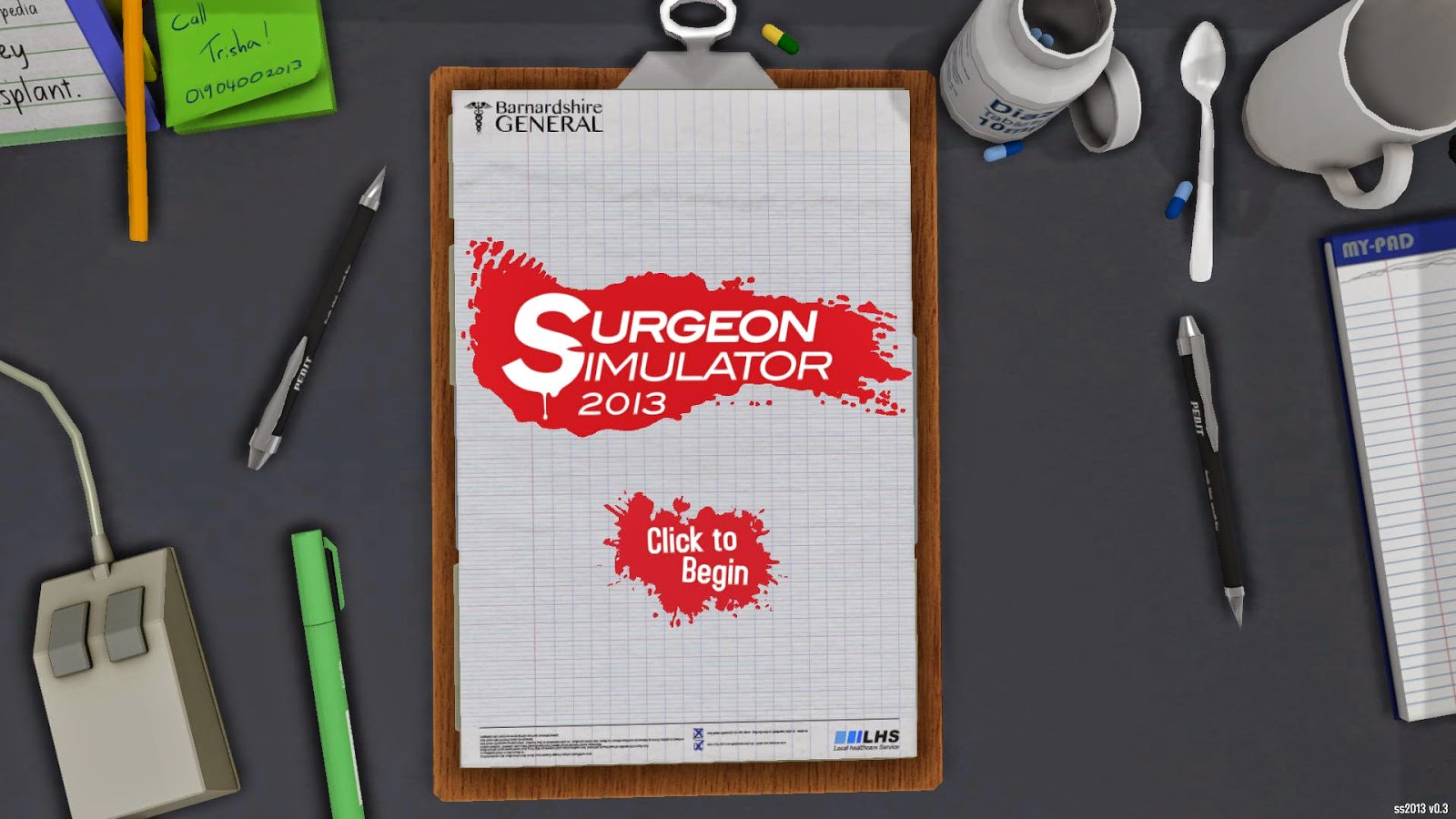
Surgeon Simulator 2014 PS4 Release Imminent!!

It's Wednesday 13th August next week, and that means it's the release date of the PS4 console port of Surgeon Simulator in a special 'Anniversary Edition'. Why is this exciting? Partly because Surgeon Simulator has been used as an appropriate form of anger management since its PC release in 2013 but also because this PS4 version will include all the best features of the Steam  and iPad versions. Not only that, but in this surge of Surgeon Simulator madness, the game will also be coming to Android on the 14th.

It won't be as difficult to part with the £8.99 or $12.99 required to purchase the game as it will be to pass even the first few levels without some hefty lawsuits (how is it even possible to be that clumsy AND shakey at the same time?).

Bossa Studios initially developed the game in a 48 hours period for the 2013 Global Game Jam, continuing afterwards for a further 48 days in order to create the terrifying ordeal we now call a game. After releasing a version designed for iPad with more features, the new PS4 console port will apparently include a previously unrevealed mode.


Friday, 8 August 2014

New Details About Last Of Us Movie

New details have emerged concerning the production and development of a film adaptation of best-selling game The Last Of Us. Neil Druckmann, the producer of the original game and now the lucky screenwriter for the film has revealed that the story will focus more on the relationship between Joel and Ellie in an effort to condense 15 hours worth of gameplay into a 2 hour film. Which is actually quite a challenge considering the sheer amount of plot depth that The Last Of Us has to offer as well as the fact that whatever poor Druckmann does with the film, it's going to be difficult to please the people who want to explore more of the universe of The Last Of Us as well as those who simply want to enjoy seeing their beloved characters and plot

come to life. Perhaps this is why so many video games simply do not cut it as films - they can either step away from the actual gameplay themselves and simply use the marketable title and the expected themes to propel themselves, or they can become a remake of the actual game itself and risk boring players who have been through it several times, got the collectables and won the trophies.

It seems like this film is in good hands though, with Sam Raimi (Evil Dead) also at the helm of production and with Maisie Williams (Game of Thrones) being heavily considered for the role of Ellie. The risk lies in the players' love for the game and the difficulty of recreating the feeling of experiencing something ground-breaking for the first time simply because of the fact that it is no longer ground-breaking.

It seems however, that Druckmann (who has pretty much been given complete creative control by Naughty Dog) is not simply remaking the game into a film - he's focussing on different aspects of the storyline and the universe of The Last Of Us in an attempt to please everyone's oh so high expectations. He's got a challenge ahead of him though - he's got power over one of the biggest topics in the video game industry at the moment and the expectations of so many fans resting on all his decisions, so as Sam Raimi's Spider-Man taught us - with great power comes great responsibility. (Well it was actually Stan Lee but they said it in the Sam Raimi film and that would fit my point a lot better...).
It seems Druckmann knows what he's
up against.